Sunday, 27 July 2014

The Worst Contracts In The NFL Right Now


One of the hot topics on people's lips as we head towards the regular season is the debate around Andy Dalton. The Bengals' signal-caller clearly possesses the talent worthy of his status as a franchise quarterback, but his struggles in the post-season (shared by the rest of the team) have led elements of the Bengals fanbase to turn against the face of their franchise.

Dalton is in a contract year, and should the Bengals go all the way, or at the very least progress further than the wildcard round, he could command a big-money contract due to the salaries of his contemporaries. It's a precarious position for franchises - they feel compelled to pay their quarterback big money despite overlooking their performance in previous years and in fear of losing them to a rival. Why would any franchise cut a super bowl-winning quarterback, right?

In short, we're looking at another Joe Flacco. Often, teams become enamoured with a player who simply isn't worth the money, or are forced into tight corners by rapidly escalating league salaries. On that note, let's take a look at the worst contracts in the NFL at the moment.

Joe Flacco

Flacco is a perfectly competent quarterback. He epitomises the expression 'solid-but-unspectacular', and is worthy of the Ravens' continued trust in him. He isn't, however, worth the gargantuan $120.6 million six-year contract he signed following Baltimore's super bowl win in 2013. His play, unsurprisingly, never returned to the level it was in the 2012 playoffs, and now his contract weighs like an albatross around the Ravens' neck. They're locked into the deal until the 2016 season, during which Flacco will have a staggering cap hit of $28.6 million, and in 2017 they can either pay him £31.2 million or losing $15.3 million in dead money. For all his successes over the past few years, general manager Ozzie Newsome dropped the ball on this one.

Michael Oher

The real-life protagonist of the inspirational book and movie The Blind Side, Oher has failed to develop into the elite left tackle he was touted as coming out of college. Oher was limited to right tackle for the majority of his time in Baltimore and left for greener pastures at the end of last season. The Tennessee Titans answered the call, and Oher signed a four-year $20 million deal with $6 million guaranteed. The Titans can get out of the contract after a year, but the drafting of Michigan's Taylor Lewan could see Oher relegated to the bench.

Dwayne Bowe


Dwayne Bowe appears to be coasting on the reputation he forged during the 2010 season. After posting 1,162 yards and 15 touchdowns that season, Bowe has managed to produce a paltry 13 in three seasons since. The five-year $56 million contract - with $20 million guaranteed - he signed in March 2013 made him the third highest-paid receiver in the league, and allowed the Chiefs to franchise tag Branden Albert (who left after the season anyway). A lot of money for a player who has failed to maintain

Jason Hatcher


Question: how does a peripheral defensive lineman like Jason Hatcher end up with a four-year contract worth $27.5 million with a $9 million signing bonus and $10.5 million guaranteed? Answer: the Washington Redskins. Who else could it be? Hatcher was a lone bright spot on an otherwise poor Dallas Cowboys defence last year with 11 sacks (he had accumulated only 16 in his previous seven seasons), and it's no coincidence that the boom in production coincided with the Cowboys' shift to a 4-3 defence. The 32 year-old Hatcher will likely struggle to recapture this form in a 3-4 defense, especially after being sidelined with a knee injury.

Karlos Dansby


Dansby doesn't appear on this list because of his production; it's hard to argue to with 114 tackles and 6.5 sacks accumulated as part of a ferocious and underrated Cardinals defensive unit last season. He appears on here because he's about to turn 33 and the Cleveland Browns offered him a four-year $24 million contract, with $14 million guaranteed. The formula for winning championship usually involves getting younger, and the Browns failed spectacularly in this regard. It's entirely possible Dansby will be solid for the Browns in 2014, but that doesn't change the fact that they paid superstar money for someone who could realistically be out of the league before his contract expires.

Thursday, 24 July 2014

Throwback Thursday: A History of NFL Training Camps

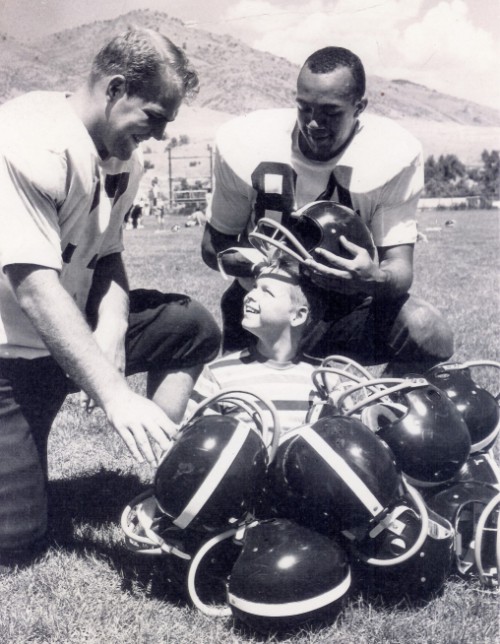
With the NFL offseason now in full swing, this edition of 'Throwback Thursday' takes a photographic look at training camps throughout history - from humble beginnings to its current status as, in true NFL style, an 'event' worthy of thousands of hours of media coverage.

Dallas Cowboys training camp, 1960's

Denver Broncos training camp, 1960

Cleveland Browns defensive linesmen (L-R); Bill Glass, Bob Gain, Dick Modzelewski, Paul Wiggin: 1964

Miami Dolphins training camp, 1970

Joe Namath and Richard Todd, New York Jets Training Camp, 1976 


Terry Bradshaw, Pittsburgh Steelers training camp, 1981

Jim McMahon and Walter Payton, Chicago Bears training camp 1986

Future Hall of Famers Joe Montana and Steve Young loosen up during 49ers training camp at Sierra College in Rocklin, Calif.
Joe Montana and Steve Young, San Francisco 49ers training camp, 1990

Packers quarterback Brett Favre is shown in 1992 in the team's locker room at Lambeau Field.
Brett Favre, Green Bay Packers training camp, 1992

Packers DE Reggie White is chased by fans during 1993 Packers training camp at St. Norbert College in De Pere, Wisc. (John Biever/SI)
GALLERY: Rare Photos of Reggie White
Reggie White, Green Bay Packers training camp, 1993

Michael Strahan, New York Giants training camp, 1999

Peyton Manning, Indianapolis Colts training camp, 2000

Pro wrestler Brock Lesnar fights through the offensive line in a morning drill during Vikings training camp in Mankato, Minn.  Lesnar played during the preseason for Minnesota, but ended up being a late cut.
Brock Lesnar, Minnesota Vikings training camp, 2004

Cincinnati Bengals training camp, 2013

Robert Griffin III, Washington Redskins training camp 2013

Johnny Manziel, Cleveland Browns training camp, 2014

Four Young Giants Poised to Rise Up In 2014


Giants football returns - finally! - after one of the most disappointing years in recent memory. It was a Giant dud of a season, filled with interceptions from Eli Manning, a decimated offensive line, a patchwork running backs unit, injuries to key players, a disappearing act by the talented Hakeem Nicks and an ineffective pass rush that produced only 34 sacks.

An unforgivable season for a proud organisation not accustomed to losing. The offseason saw a drastic overhaul on both sides of the ball, and many long-term coaches and players were released. Ben McAdoo replaces the much-derided Kevin Gilbride as offensive coordinator and has brought with him a revamped offensive staff, and Jerry Reese indulged in a shopping spree that brought in big-name free agents including Dominique Rodgers-Cromartie, Geoff Schwartz and Rashad Jennings.

The G-Men looked to get younger on both sides of the football, and this season a group of relatively unknown or unheralded rookie, sophomore and third year players will be thrust into the spotlight as they look to take the reigns at a host of key positions for the Giants.

David Wilson

If you were to turn the clocks back exactly one year, David Wilson would likely have been featured on many articles just like this one. Wilson may have failed to live up to his billing as a first round draft pick, but the physically gifted running back has been cleared to play by doctors, and is now operating in a scheme that that suits his talents far better than the last. Despite the arrival of Rashad Jennings and rookie Andre Williams, Ben McAdoo's west coast offense will likely utilise Wilson in the passing game, where he should feature heavily. With the potential to break off huge runs from swing and screen passes, he is certainly athletic enough to become a nightmare for defences.

Jonathan Hankins

While the departure of Linval Joseph to Minnesota was painful, the presence of Hankins means the Giants won't miss him too badly. The second-year defensive tackle from Ohio State boasts prototypical 1-technique size and in his rookie season, with limited opportunities, demonstrated he has what it takes to be a more-than-effective run-stopper. With vastly increased playing time, fans can expect Hankins to establish himself as one of the league's best run-stopping defensive tackles.

Devon Kennard

Damontre Moore could have been an option here, but the arrival of Robert Ayers makes the defensive end position a bit of a grey area, so I've opted for a more 'left-field' choice.
Only yesterday I wrote about the replacements for Jon Beason, identifying the now-injured (albeit not severely) Jameel McClain as the leading candidate for the temporary vacancy. Thankfully they may have discovered a gem in fifth round draft pick Devon Kennard. Kennard has a chance to stamp his name on the middle linebacker spot if Beason and McClain miss extended time this season, and if that situation doesn't unfold he could realistically start at either of the outside 'backer positions. Big (6'3", 251 lbs), hard-hitting and - most importantly - intelligent, the USC product has everything it takes to breakout this season.

Adrien Robinson

In the eyes of most fans and analysts, the Giants have no starting tight end. Following the loss of Martellus Bennett prior to last season and the disappointing Brandon Myers in February, there has been no clear starter at the position. In Kellen Davis, Larry Donnell, Daniel Fells, Xavier Grimble and Adrien Robinson, the Giants have five players with legitimate shots at earning the starting job, but only one has true breakout potential. Adrien Robinson was a raw prospect out of Cincinnati in 2012 (he only caught 29 passes in his entire college career) and remains an unknown quantity in his third season, but possesses all of the physical tools necessary to become an elite NFL tight end. He is easily compared to Denver's Julius Thomas which, given the enormity of the  Bronco's performance last year, is certainly a welcome one.

Wednesday, 23 July 2014

The Next Man Up


John Feinstein's 2005 book 'Next Man Up: a Year Behind the Lines in Today's NFL' is a gripping, no-holds-barred account of the highs and lows of the Baltimore Ravens' 2004 season. It's an essential read for anyone remotely interested in American football or, indeed, sport at any level.

While the book may have covered the season of just one team, the title applies to all 32 NFL teams and is a phrase that always rears it's ugly head around July and August: training camp. Between organised Team Activities (OTA's) through to the end of the four-game preseason, NFL players are at risk of every kind of season- limiting injury - from torn ACLs and sprained MCLs to herniated discs and dislocated elbows.

Scheduling changes - including the 2014 NFL draft being pushed back until early May - have seen the offseason shortened in an attempt to eliminate overzealous workouts and mini training camps, and yet teams have already seen vitally important players in key positions fall victim to injuries. This article aims to shed some light on the impact of their loss on their respective teams.

Chris Hairston

You are forgiven for being unfamiliar with Chris Hairston. The fourth-year pro replaces not one but two Buffalo Bills offensive linemen after illness sidelined starter Cordy Glenn, and injury struck Seantrel Henderson - his replacement.
Glenn may not be out for the season, but seeing as coach Doug Marrone is reportedly "not allowed to speak" about his illness, we can assume he'll be out of action for a while.
The significance of this comes in the strength of Buffalo's run game. Glenn was a stud in 2013 (he scored a +23.0 on Pro Football Focus last season) and was the stand-out player on a disappointing line (ranked 22nd and given a -12.5 overall rating by PFF). The Bills have stocked up on offense, but a misfiring run game could pile pressure on EJ Manuel and make shutting down an explosive passing game that much easier for defenses.

Giants' Linebackers


Jon Beason experienced a renaissance of sorts in 2013. He was back to his best against the run, made plays all over the field and emerged into a linchpin defensive leader that the Giants have so desperately needed since Antonio Pierce retired in 2008. His injury problems appeared to be behind him - until he suffered a sesamoid bone fracture in his foot during minicamps.
The good news is that this isn't a recurring injury, he doesn't require surgery, and he is tentatively expected back before the season. However, the unconvincing Mark Herzlich and free agent pick up Jameel McClain will be picking up the slack in his absence. His potency against the run will be missed, but it is his on-field leadership that the Giants will suffer without the most.

Falcons Linebackers


Now we enter the realm of season-ending injuries. Sean Weatherspoon missed most of last season, and it is no surprise the Falcons were porous on defence as a result. Entering a contract year, Weatherspoon would have been expected to post a statistically strong season but instead he finds himself sitting on injured reserve with a ruptured achilles tendon. Fortunately for the Falcons, they have a group of intriguing prospects with a lot of potential. Paul Worrilow (99 tackles in 2013), Joplo Bartu (3.5 sacks in 2013), rookie Prince Shembo and the injury-prone Pat Angerer attempt to replace the Falcons' defensive standout. Rough times ahead for an already struggling unit.

Nigel Bradham


As you can see, it's not been a good offseason for the Buffalo Bills. With starting left tackle Cordy Glenn already missing time through injury, the loss of Kiko Alonso for the year comes as another huge blow. Alonso overcame concerns about his size to become the team's leading tackler (third in the league with 159), and the PFWA defensive rookie of the year. That kind of production can't easily be replicated, and it spells bad news for a unit poor against the run in 2013. Thankfully the Bills brought in linebacker depth in the form of Keith Rivers and Brandon Spikes, but neither man is suited for the free-roaming role Alonso played. High starting reps in training camp suggests that the job is the athletic, playmaking Nigel Bradham's to lose, but he faces competition from Preston Brown and Stephenson Sylvester.

Cowboys Linebackers


Linebackers might want to start taking it easy in these offseason practices, however alien the concept of 'taking it easy' may seem to them. The Cowboys' most irreplaceable defensive player had the misfortune of suffering a season-ending ACL injury in first OTA of the year.
Another defence that struggled last season, the impact of Lee's loss will be seen in both on field performance and leadership. The unproven but physically and instinctively gifted Devonte Holloman is the top candidate, but is nursing an injury of his own. Justin Durant, Anthony Hitchens, Dontavis Sapp and Orie Lemon have been filling in during camp, and - in true Cowboys style - the team traded for the troubled and retirement-prone Rolando McClain, and even considered making a play for Brian Urlacher. 

Given that most teams are only just kicking off their training camps, and with four preseason games on top of that, don't be surprised if this list is far longer come the season's opening weekend.

Sunday, 23 February 2014

Throwback Player Profile #5 - Kevin Greene


The past few 'throwback player' features have included current or soon-to-be Pro Football Hall of Fame-ers. This week I'll be taking a look at someone who probably should be, but has fallen short over the last few years: Kevin Greene.

Accumulating 160 sacks (third all time) in a fourteen-year career, Greene is often dismissed on the grounds that he was a 'one trick pony'. Greene was never the most complete player, but if a coach had to pick one 'trick' for an 3-4 outside linebacker to excel at, pressuring the quarterback would likely be top of his list.

Kevin Greene excelled at sacking the quarterback the same way Cris Carter, Andre Reed, Terrell Owens and Marvin Harrison excelled at catching passes.

This tenacious ability to inflict pain on opposing quarterbacks manifested itself while he was at the University of Auburn. After some time in the National Guard, Greene attempted to forge himself a career in football as a walk-on player (he was not offered a scholarship to play college football). He introduced himself to his future coaches with a supremely confident declaration: "Hey, Coach, I'm Kevin Greene and I'm your starting outside linebacker". Greene quickly emerged as a force on defence - winning the Zeke Smith award in 1984 after only two seasons - and leading the SEC in sacks in his senior year with eleven.

Greene is known for being somewhat of a 'journeyman' player, and his first port of call was the Los Angeles Rams - who had drafted him in the fifth round of the 1985 NFL draft. He was immediately given a chance to play as the Rams ran a five-linebacker defence, and in his first two seasons as a regular he amassed 13.5 sacks. Despite the Rams' changing their defensive scheme from a 3-4 to a 4-3, Greene still managed to amass 72.5 sacks, including two consecutive seasons (1988 and 1989) with 16.5 sacks. 


With the advent of free agency, Greene went looking for teams that employed a more familiar 3-4 scheme, and found a new home in the form of Dom Capers' Pittsburgh Steelers defence. He flourished, and recorded 12.5 sacks in his first year with the team, 14 in his second season and in 1994 he was named a consensus All Pro. Alongside Greg Lloyd, Chad Brown and Levon Kirkland, Kevin Greene was an integral member of one of the greatest linebacking corps of all time, and the group are still favourably compared to the great Steelers' linebackers of the 1970's.
Greene hopped around from team to team for the last few years of his career, and this arguably counts against him when being considered for the Hall of Fame. A short stint (three seasons) in Pittsburgh preceded one season with the newly-formed Carolina Panthers and another with the San Francisco 49ers before returning to Carolina for the final two years of his career. A super bowl ring remained elusive, but over his last four seasons Greene amassed an incredible 52 sacks, was named the National Football League Players Association linebacker of the year and reached his fifth and final Pro Bowl in 1998.


It's strange that this should hinder his case for entry. Sure, most Hall of Fame players spent the majority of their careers within one organisation but, despite his nomadic existence, Greene was a model of remarkable consistency. He never experienced a decline in his production - he is still the oldest player to lead an NFL season in sacks with 14.5 in 1996 at the age of 34 - and is one of only three players in NFL history to record ten or more sacks in at least as many seasons.
Greene finished with 160 of them - third all time behind Hall of Famers Bruce Smith and Reggie White, and ahead of Chris Doleman, Michael Strahan, John Randle, Richard Dent and Lawrence Taylor. All of whom are, unsurprisingly, in the Hall of Fame. He also holds the record for most sacks by a linebacker (27.5 sacks ahead of Taylor).

Another argument for his omission is that he was a pure sack artist and not a complete defensive player. While he undoubtedly specialised in this area, it is not coincidence that defences featuring Greene as a prominent starter were also dominant run-stopping units. Between 1988 and 1990 (Greene's first three as a starter) teams averaged only 3.9 yards per rush against the Rams. In his time with the Steelers and 49ers, teams averaged 3.48 and 3.5 yards per rush, respectively, and Greene ended his career with a respectable 52 tackles for loss.


Kevin Greene's admission to the hall of fame is a matter of 'when' not 'if'. He has a super bowl ring as a coach (with the Packers) to boost his claim, but the past few classes have been stacked with elite defensive candidates - almost all of the players above and below Greene on the all-time sacks list were enshrined after Greene became eligible in 2005 - and future classes are set to feature Ray Lewis, Jason Taylor, Charles Haley and John Lynch.

Greene himself said: "The Hall of Fame voters, if they would look at my entire body of work, how I played, maybe they'll see fit to put me in... commitment, passion, study habits, workout habits... everything I did I think I did it the right way."

He might have to wait a while, but in a highlight reel-obsessed league voters simply cannot - and will not - ignore Greene due to his production.

Wednesday, 5 February 2014

Super Bowl XLVIII: Seattle Seahawks 43 - Denver Broncos 8

Ten-Point  Stance: Mike Freeman's NFL Notebook Post-Super Bowl XLVIII


Be honest: you didn't see that one coming.

All of the score predictions, all of storylines going into the game, all of the drama surrounding Richard Sherman, and all of the questions about whether Champ Bailey or Peyton Manning would retire after the game became completely irrelevant once Broncos centre Manny Ramirez snapped the ball clean over Peyton Manning's head on the first play of the game.

The ball flew into the endzone and was grounded by the Broncos for a safety. The Seahawks had two points before Russell Wilson and co. had even taken the field. The last time a Super Bowl had opened with a safety? The Giants got one on the way to a 21-17 win over the Patriots in Super Bowl XLVI. The signs didn't look good for Denver.


It's tough to call - and maybe this was always going to be the case - but from that moment on, Manning and the Broncos looked nervous and edgy. They never found their rhythm on offense, and their defense failed to stop the Seahawks as they marched to a 22-0 lead before half time.

Seattle were just as advertised: a ferocious defense and a versatile, explosive offense that scorched the Broncos for four touchdowns. Percy Harvin accumulated 137 all-purpose yards and Russell Wilson was quietly flawless - 18 of 25 for 206 yards, two touchdowns and 36 yards rushing off three attempts. On defence the Seahawks' standout was not Richard Sherman, Kam Chancellor or Earl Thomas, but Malcolm Smith. Smith earned MVP honours with a performance that included a 69-yard interception return touchdown, a fumble recovery and nine solo tackles.


It was a bizarre spectacle - never before has a team gone from being almost overwhelming favourites to being completely out of the game so quickly.
So why did it go wrong for Denver? The answer's simple: Denver weren't as good as people thought. Sure, they had a record breaking regular season, but they faced only three teams with a top-15 defence, and none of them were even close to the quality of Seattle. By contrast, the 2007 New England Patriots beat eight teams with top-15 defences in the regular season.

Seattle were merciless in pursuit of their first Super Bowl title and - to their credit - Denver never looked like they weren't trying; they just simply weren't good enough. The always-outspoken Richard Sherman was spot-on when he said that the San Francisco 49ers, and not the Broncos, were the second-best team this year.


Saturday, 1 February 2014

Super Bowl Tips For Beginners


Despite this weekend featuring a tantalising Premier League matchup between Chelsea and Manchester City, as well the first round of the Six Nations, it ultimately belongs to that great celebration of all things American: the Super Bowl.

Even if you've never watched a single minute of NFL action, you'll likely be vaguely familiar with the Super Bowl. So, if you're planning on watching the game - but aren't quite sure what it all means - then this guide is for you.

1. I don't understand the rules


For many people in the UK, the Super Bowl - and the NFL - is a once-a-year spectacle. It's not every day you get to drink in a bar until 4am, right? Even so, it does help to understand what's going on.
So what are the rules? A game of football/American football/'NFL' takes place over four fifteen-minute quarters, and the clock is only running while the ball is in play. This means that, in real-time, the game runs for over 3 hours.
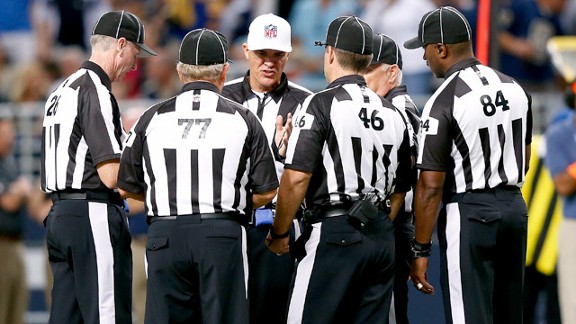
Teams get four opportunities ('downs') to travel ten yards by passing or running the football. If they succeed, they get another set of downs. If they fail, they have to turn the ball over by punting to the opposition. This continues until one team scores a touchdown (7 points) or a field goal (3 points). The team who scored then kicks the ball to the other team, and they then get a chance to drive down the field and score. If a player is penalised, a referee will throw a yellow flag on to the field and - rather than award a team a free kick or a penalty attempt - they will penalise the offending team in yardage.

2. The Quarterback is the most important player on the field


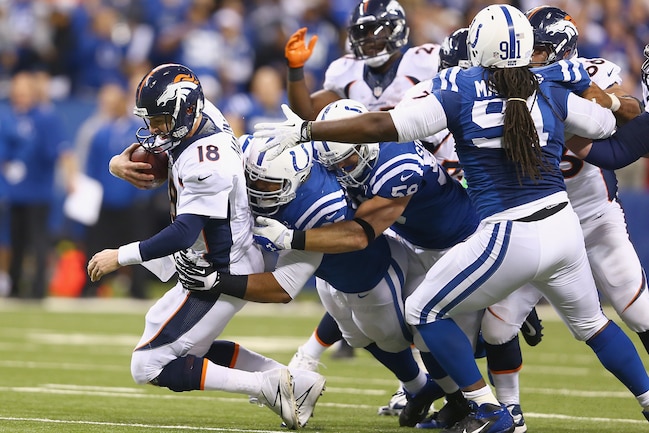
Yes, the guy who throws the ball is the most important player on the field. He'll touch the ball on just about every play, and it is the first priority of the defence to limit his effectiveness. They do this by trying to break up passes to other players, or by hitting him as hard as possible before he can get rid of the ball (a sack). On Sunday you'll see Peyton Manning (Denver) and Russell Wilson (Seattle). A serious injury to either of these guys will make it much harder for their respective teams to win.


3. So what is the Super Bowl?


The NFL is divided into two conferences; the AFC and the NFC. At the end of each season the best teams in each conference will play among each other until one team remains from the AFC and the NFC. Yes, you are correct - those two teams then play in the Super Bowl to determine the NFL ('world') champion.
Imagine splitting the Premier League in two and making the winner of each league play each other at Wembley.
Sunday marks the 48th Super Bowl, and the Pittsburgh Steelers are the most successful team with six wins. As you can see, it was pretty easy to get tickets for Super Bowl I in 1967, but nowadays tickets can cost as much as $2,500 (at face value).

4. The teams.


The AFC champions are the Denver Broncos - led by Peyton Manning (you may have heard of him), they've enjoyed a historic season in which they managed to score more points than any other team in history. Despite their frighteningly talented offence, they are let down by a middle-of-the-road defence and will aim to score early and often in order to limit the options of the Seattle offense. This is their seventh appearance in the big game, and they've not won it since 1999.
Seattle are the NFC champions. Their quarterback is Russell Wilson (you probably haven't heard of him), and they are arguably a more complete team than their opponents. The Seahawks have a good-but-unspectacular offense, and boast an immensely physical defense (the best in the league). The Seahawks have never won a Super Bowl, but in recent years have emerged as the 'next big thing'. If you're looking for a bandwagon to jump on, Seattle are your team.

5. It's more than just a game


Make no mistake, the Super Bowl is more than two teams playing for a trophy. For many Americans, it is a national holiday (be prepared to take Monday off work) and much of the fun comes from the pomp and the spectacle of its non-sporting features. A 30-second commercial during one of the many advert breaks during the Super Bowl will cost $4 Million, and in 2014 you'll be able to see Scarlett Johansson, David Beckham, The Muppets and Ben Kingsley all promoting a number of products you most likely won't be able to buy in the UK. They won't be on the Sky Sports or Channel 4 broadcasts, but you can check them out on NFL.com the day after.
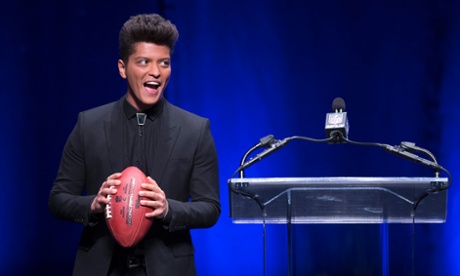
The half-time entertainment is also an event unto itself, and recent Super Bowls have seen Prince, Bruce Springsteen, The Who, Beyonce, and Madonna all fill the prestigious 15-minute slot. This year it'll be Bruno Mars and the Red Hot Chili Peppers' turn.

6. Food


If you made a new year's resolution to lose weight and/or eat healthy - you may need to suspend those plans. The Super Bowl is a phenomenally unhealthy affair and it is said that, during the game, the average American will consume 1,200 calories and 50 grams of fat in snacks alone. That doesn't include alcoholic beverages. If you're a beginner watching at a bar or at home with die-hard NFL fans, tradition dictates you must partake in the eating of unhealthy snacks.
7. When does it start?
One of the most Googled questions around this time of year, the Super Bowl starts at 6.30pm ET, or 11.30pm GMT. Providing there isn't another power cut in the stadium (as was the case in 2013) the game will likely end around 10.30pm EST, or 3.30am GMT.

If you've got any further questions, send them my way on Twitter @TomMacFootball