Showing posts with label Super Bowl 48. Show all posts

Saturday, 1 February 2014

Super Bowl Tips For Beginners


Despite this weekend featuring a tantalising Premier League matchup between Chelsea and Manchester City, as well the first round of the Six Nations, it ultimately belongs to that great celebration of all things American: the Super Bowl.

Even if you've never watched a single minute of NFL action, you'll likely be vaguely familiar with the Super Bowl. So, if you're planning on watching the game - but aren't quite sure what it all means - then this guide is for you.

1. I don't understand the rules


For many people in the UK, the Super Bowl - and the NFL - is a once-a-year spectacle. It's not every day you get to drink in a bar until 4am, right? Even so, it does help to understand what's going on.
So what are the rules? A game of football/American football/'NFL' takes place over four fifteen-minute quarters, and the clock is only running while the ball is in play. This means that, in real-time, the game runs for over 3 hours.
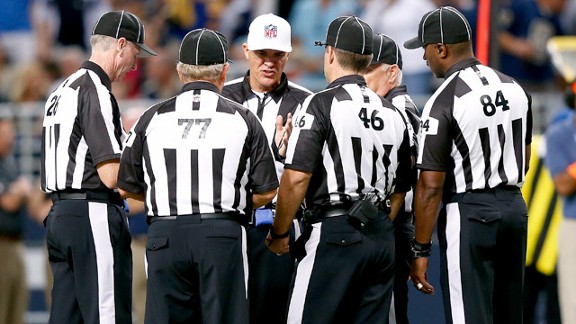
Teams get four opportunities ('downs') to travel ten yards by passing or running the football. If they succeed, they get another set of downs. If they fail, they have to turn the ball over by punting to the opposition. This continues until one team scores a touchdown (7 points) or a field goal (3 points). The team who scored then kicks the ball to the other team, and they then get a chance to drive down the field and score. If a player is penalised, a referee will throw a yellow flag on to the field and - rather than award a team a free kick or a penalty attempt - they will penalise the offending team in yardage.

2. The Quarterback is the most important player on the field
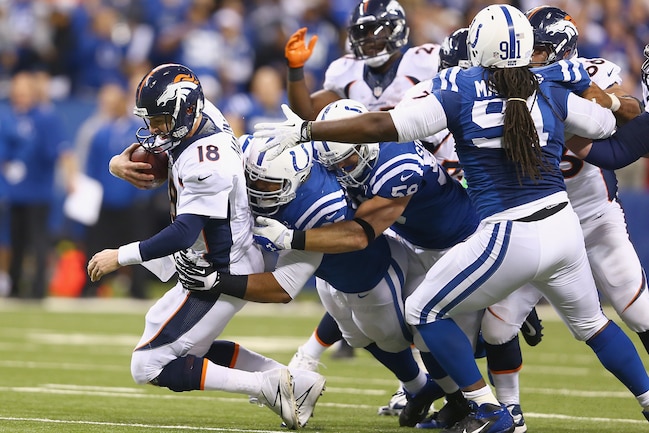


Yes, the guy who throws the ball is the most important player on the field. He'll touch the ball on just about every play, and it is the first priority of the defence to limit his effectiveness. They do this by trying to break up passes to other players, or by hitting him as hard as possible before he can get rid of the ball (a sack). On Sunday you'll see Peyton Manning (Denver) and Russell Wilson (Seattle). A serious injury to either of these guys will make it much harder for their respective teams to win.


3. So what is the Super Bowl?
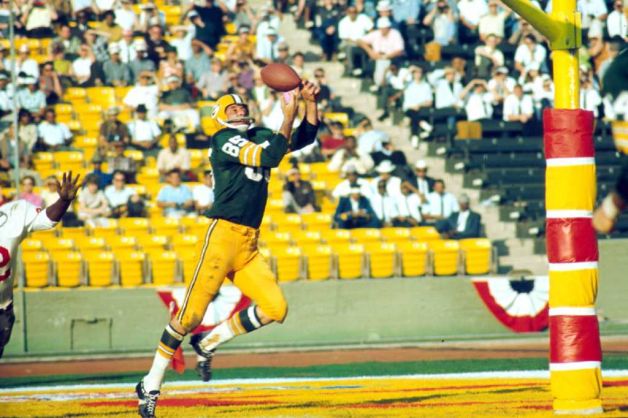


The NFL is divided into two conferences; the AFC and the NFC. At the end of each season the best teams in each conference will play among each other until one team remains from the AFC and the NFC. Yes, you are correct - those two teams then play in the Super Bowl to determine the NFL ('world') champion.
Imagine splitting the Premier League in two and making the winner of each league play each other at Wembley.
Sunday marks the 48th Super Bowl, and the Pittsburgh Steelers are the most successful team with six wins. As you can see, it was pretty easy to get tickets for Super Bowl I in 1967, but nowadays tickets can cost as much as $2,500 (at face value).

4. The teams.


The AFC champions are the Denver Broncos - led by Peyton Manning (you may have heard of him), they've enjoyed a historic season in which they managed to score more points than any other team in history. Despite their frighteningly talented offence, they are let down by a middle-of-the-road defence and will aim to score early and often in order to limit the options of the Seattle offense. This is their seventh appearance in the big game, and they've not won it since 1999.
Seattle are the NFC champions. Their quarterback is Russell Wilson (you probably haven't heard of him), and they are arguably a more complete team than their opponents. The Seahawks have a good-but-unspectacular offense, and boast an immensely physical defense (the best in the league). The Seahawks have never won a Super Bowl, but in recent years have emerged as the 'next big thing'. If you're looking for a bandwagon to jump on, Seattle are your team.

5. It's more than just a game
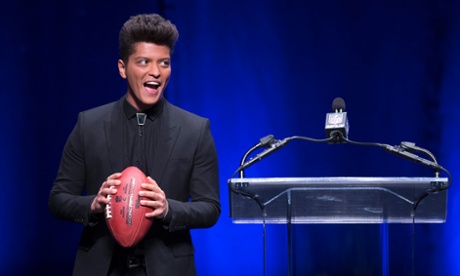


Make no mistake, the Super Bowl is more than two teams playing for a trophy. For many Americans, it is a national holiday (be prepared to take Monday off work) and much of the fun comes from the pomp and the spectacle of its non-sporting features. A 30-second commercial during one of the many advert breaks during the Super Bowl will cost $4 Million, and in 2014 you'll be able to see Scarlett Johansson, David Beckham, The Muppets and Ben Kingsley all promoting a number of products you most likely won't be able to buy in the UK. They won't be on the Sky Sports or Channel 4 broadcasts, but you can check them out on NFL.com the day after.
The half-time entertainment is also an event unto itself, and recent Super Bowls have seen Prince, Bruce Springsteen, The Who, Beyonce, and Madonna all fill the prestigious 15-minute slot. This year it'll be Bruno Mars and the Red Hot Chili Peppers' turn.

6. Food


If you made a new year's resolution to lose weight and/or eat healthy - you may need to suspend those plans. The Super Bowl is a phenomenally unhealthy affair and it is said that, during the game, the average American will consume 1,200 calories and 50 grams of fat in snacks alone. That doesn't include alcoholic beverages. If you're a beginner watching at a bar or at home with die-hard NFL fans, tradition dictates you must partake in the eating of unhealthy snacks.

7. When does it start?

One of the most Googled questions around this time of year, the Super Bowl starts at 6.30pm ET, or 11.30pm GMT. Providing there isn't another power cut in the stadium (as was the case in 2013) the game will likely end around 10.30pm EST, or 3.30am GMT.

If you've got any further questions, send them my way on Twitter @TomMacFootball

Thursday, 30 January 2014

Throwback Player Profile #4 - Walter Jones


If you've seen the film 'The Blind Side', or read the book of the same name, you'll be aware of the game-changing nature of Giants linebacker Lawrence Taylor's hit on Joe Theismann in week 11 of the 1985 NFL season. Taylor revolutionised the game in that his presence alone forced teams to invest heavily in left tackles - finding a player to anchor the offensive line and protect their quarterback's blind side became teams' top priority.

In the twenty-eight years since that night, teams have tried - and often failed - to find that man. Some, like Willie Roaf, Gary Zimmerman, Jonathan Ogden, Orlando Pace and Joe Thomas, have been exemplary...but arguably none of them have been as good as Walter Jones.


Ex-Seahawks quarterback and current Seahawks radio analyst Warren Moon explains why Jones was so good:

"Walter just had a rare combination of great feet, but powerful strength - especially in his lower body...that allowed him to not only be able to stay in front of some of the best defensive ends in the league...he also had that power just to come off and just annihilate whoever was in front of him in the running game. So he not only was a good pass blocker, he was a great run blocker, he was a great run blocker as well. He was the whole package."

It's tough to find a left tackle statistically superior to Jones, as over the course of his twelve-year career he didn't miss a single game (playing 180 in total), was selected to nine Pro Bowls - a franchise record - and was a six-time All-Pro. He only drew nine penalty flags in 5,703 pass plays - once every 634 plays - and allowed only 23 sacks in his entire career.
The many quarterbacks who started for Seattle during his tenure - John Freisz, Warren Moon, Jon Kitna, Glenn Foley, Brock Huard, Matt Hasselbeck, Trent Dilfer, Seneca Wallace, Charlie Frye and Charlie Whitehurst - only experienced pressure from their blind side (or in Brock Huard's case, his 'not-so-blind side') only once in every 248 pass plays. It's also no coincidence that Shaun Alexander was named the NFL MVP behind an offensive line with Jones as a permanent feature.


Those are remarkable statistics for a man who enjoyed an extraordinarily dominant career. As a result he was named by The Sporting News as the best player in the game at any position in 2005, was named on the NFL All-2000's team, and this week he figures to be honoured as a first-ballot inductee to the Pro Football Hall of Fame.
Walter Jones was a once-in-a-lifetime talent, and once-in-a-lifetime talents deserve to be first-ballot Hall of Famers.

Throwback Thursday: NFL Stars In The 'Wrong' Uniforms

Even though it has been two years since he traded the white and blue of the Colts for the Orange Crush of the Broncos, it will still be strange to see Peyton Manning playing in another Super Bowl for a team other than the Indianapolis Colts.

Of course, Manning is not the first NFL star - or even the first member of his family - to resist retirement and spend the last few years of their career in unfamiliar surroundings. Here's a collection of some of the biggest names in NFL wearing not-so-iconic uniforms.

Johnny Unitas: San Diego Chargers, 1973

Joe Namath: St Louis Rams, 1977

Brett Favre: New York Jets, 2008

Earl Campbell with the Saints
Earl Campbell: New Orleans Saints, 1984-1985

Jerry Rice: Seattle Seahawks, 2004

Jerry Rice: Denver Broncos, 2005

O.J. Simpson: San Francisco 49ers, 1978-1979

Reggie White: Carolina Panthers, 2000

Deion Sanders: Baltimore Ravens, 2004-2005

LaDainian Tomlinson: New York Jets, 2010-2011

John Lynch: New England Patriots, 2008

Cris Carter: Miami Dolphins, 2002

Emmitt Smith: Arizona Cardinals, 2003-2004

Kurt Warner: New York Giants, 2004

Ronnie Lott: New York Jets, 1993-1994

Joe Montana: Kansas City Chiefs, 1993-1994

Thursday, 23 January 2014

Throwback Player Profile #3 - Floyd Little


On this Throwback Thursday, seeing as we are little over a week away from Super Bowl XLVIII, I'll be taking a look at one of the greatest Broncos of all time - Floyd Little.

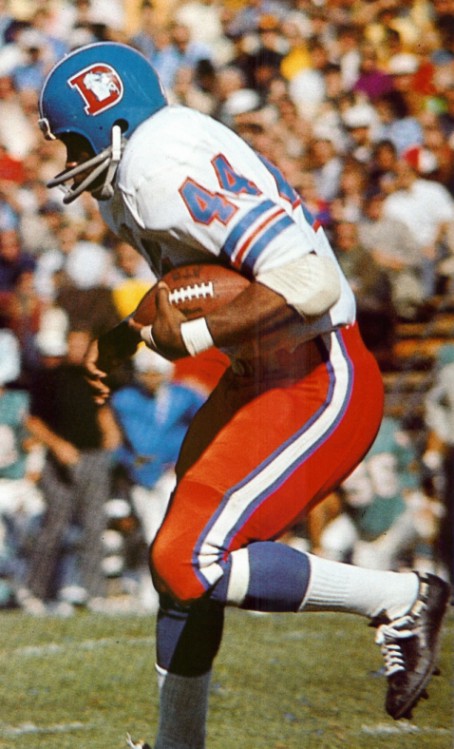
When one looks back over his career, it is hard to believe it took him so long to reach the Pro Football Hall Of Fame. The running back was the owner of Syracuse university's famed #44 jersey after Jim Brown and Ernie Davis, and was the first player drafted by the newly-created Denver Broncos in 1967. Understandably, his nickname - to Broncos fans, at least - remains 'The Franchise'.

Of course, Little didn't receive such an esteemed nickname solely because of his status as a first round draft pick - he earned it with immediate and sustained success on the football field.

Little was initially used as a kick and punt returner, and quickly flourished at the pro level. In his rookie season he led the American Football League in punt returns (16.9 avg on 16 returns) and set a career-best record for kick returns - returning 35 kickoffs for 942 yards. He scored the AFL's only punt return touchdown that season, and - with rushing and receiving yardage totalling just under 400 yards - was responsible for almost 1,500 all-purpose yards.

As Little matured as a running back, he started to see more carries and established himself as the prominent component of the Denver Broncos offense. He was averaging five yards per carry by his third season, caught 25 passes in each of his final five years in the league, became the first 1,000-yard rusher in franchise history in 1971 and won the NFL rushing title in the same year with 284 carries for 1,133 yards and six touchdowns.


His explosive running and pass-catching abilities made him a fan favourite in Denver, and he arguably helped pave the way for guys like Barry Sanders, Roger Craig, Marshall Faulk and - in today's NFL - Reggie Bush and Danny Woodhead.

When he retired, Little had accumulated over 12,000 all-purpose yards - more than anyone in the league between 1967 and 1975 - and ranked seventh on the all-time leading rushers list (with 6,323 yards and 54 touchdowns) behind an offensive line without a single pro bowler.
He was named to three Pro Bowls (in 1970, 1971 and 1973), the AFC all-star game (in 1968 and 1969), and was inducted to the Broncos ring of fame and - finally - the Pro Football Hall of Fame in 1984 and 2010 respectively.

But Floyd Little's significance to the Broncos runs much deeper than rushing records and all-purpose touchdowns - he is arguably the very reason that Peyton Manning and Co. are even in the Super Bowl next Sunday. Little's success created a bond between the city of Denver and it's new football franchise - hugely significant considering Denver almost lost the Broncos in 1965.

They don't just call him 'The Franchise' for nothing.


Monday, 20 January 2014

Photo Gallery: Championship Weekend

Another Championship Weekend is in the books, and true to form it was one of the best Sundays the NFL has seen this year. Tom Brady and the New England Patriots fell short against a Denver team that always seemed destined to make the Super Bowl this season, and Pete Carroll's Seattle Seahawks saw off their bitter San Franciscan rivals to finally book a place at the big one.

Here are some of the web's best photos of the AFC and NFC Championship games:


Richard Sherman: Crazy Person?


Anyone with even a vague knowledge of the NFL knows that Richard Sherman is one of its biggest characters and most talented players. He talks the talk but can - most importantly - walk the walk.

So, the outrage over one of the NFL's most outspoken individuals saying something, erm, outspoken is baffling.


Last night, following the Seahawks emphatic come-from-behind win over their bitter rivals, Sherman launched into a tirade about Michael Crabtree and the perceived disrespect in the 49ers decision to target Sherman on a scoring attempt late in the game:

"I'm the best corner in the game. When you try me with a sorry receiver like Crabtree, that's the result you gonna get. Don't you ever talk about me...don't you open your mouth about the best or I'm gonna shut it for you real quick"

Sherman was interviewed minutes after securing his team's second ever super bowl appearance and was, as human beings from all walks of life are prone to do, caught up in the heat of the moment. He was interviewed later that night and was his usual articulate self. His column on SI.com today saw him heap praise on his teammates and opponents.

What he said isn't new. Smack talk has existed within the NFL for decades - and some of the most revered figures in the sport have had some of the biggest mouths - and can only be seen as a verbal manifestation of the more-violent-than-usual nature of the game that had preceded them: a game that immediately went down as a classic.


The week before, Kaepernick openly mocked Cam Newton's patented 'Superman' celebration, and received little-to-no backlash. Throughout the course of the game, and in the week leading up to it, Crabtree himself had been speaking ill of the Seahawks cornerback. Again, he received little in the way of condemnation, least of all from Sherman - who remained silent all week.

Richard Sherman isn't classless, nor is he a thug. He graduated with a masters degree from one of the most academic colleges in the US, has nothing in the way of off-field issues, a criminal record or even a reputation for dirty play on the field.

Sure, from childhood we are taught to be gracious in defeat and humble in victory. To show respect for our opponents and to not gloat - in fear of looking unprofessional, unsportsmanlike and just plain rude. Sherman's behaviour directly contradicts that, but when sports fans tend to idolise forthright characters, it seems a little hypocritical to crucify him for the same thing.

I am of the opinion that the rant was ill-timed and he did little but show himself in an arrogant light, but does he deserve the vitriolic, racist abuse that he's been receiving? Certainly not.